

As the Responsible Supply Chain Conference (RSCC) London approaches, Logistics Manager profiles the experts set to speak at the renowned event.
Organised by Aurora Insights with Logistics Manager, the event will take place at the prestigious 30 Euston Square, London – a Grade II listed events venue in the heart of central London.
From raw material extraction to last-mile delivery, supply chains are being tested by disruption, higher disclosure expectations and growing scrutiny of labour, sourcing and environmental impact.
Organisations that can evidence progress, manage risk in their supplier base and convert sustainability goals into operational execution will be better placed to protect reputation, maintain access to markets and build resilience.
Packed into a singular in-depth day, RSCC focuses on platforming industry experts that tackle these challenges face on, determining whether responsibility is real in practice and how sustainability affects everything from product and packaging design choices, supplier due diligence and assurance, credible emissions reporting and reduction, operational decarbonisation and the operating model required to embed progress.
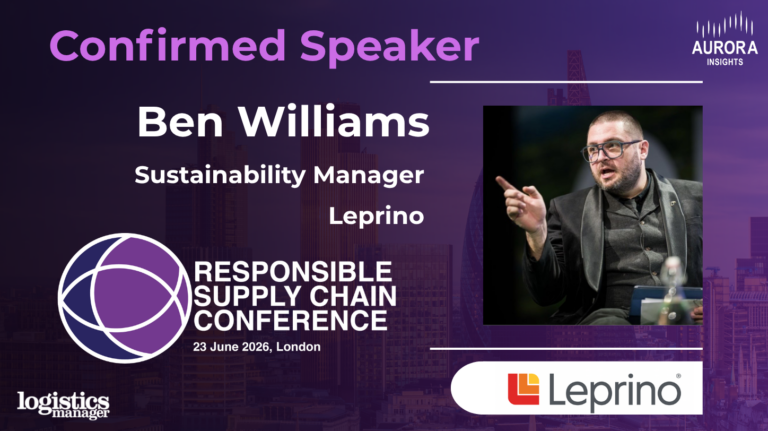
One of the experts confirmed to speak at the event is Benjamin Williams, sustainability manager at Leprino.
Williams joined the company back in 2022, having previously worked as a sustainability manager in the agriculture industry for over a decade.
Resultantly, Williams brings with him a wealth of practical agriculture, supply chain and processing as well as lean operations on farm experience.
Name: Benjamin Williams
Job Role: Sustainability Manager
Organisation: Leprino
What do you see as the biggest challenge organisations face when trying to move from sustainability commitments to real implementation across global supply chains?
We see three main barriers, economics (current procurement strategies do not support engagement in sustainability beyond scope 1 & 2), lack of insights (everyone is obsessed with data but its rarely used to provide useful insights) and skills (you can have all the money and data in the world but if you don’t have the skills to know where and how to spend it to deliver value, it’s pointless).
How can companies improve the quality and reliability of Scope 3 emissions data while working with large and complex supplier networks?
There has to be an understanding of shared value. Why should a supplier (farmer or processor) send data which has cost significant amounts upwards unless there is a commitment to move value back down the supply chain? That value does not always have to be direct cash payments but providing insights back that support efficiency and competitiveness is a form of value. Information needs to flow both ways, if you want my data, provide me value back. Also, make it easy, asking for something that takes hours and has no obvious business benefit is likely to be very frustrating.
What practical steps can organisations take to strengthen supplier governance and ensure meaningful human rights due diligence throughout their supply chains?
I think we need to move beyond simply ensuring governance and ensure we see action. The challenge with a number of governance frameworks is they do not naturally lead to action as they fail to look at the enablers of change. The first major move should be to ensure that the sustainability team and the procurement team have the same pay related performance objectives and a common framework to enable sustainable procurement.
How is the concept of the circular economy evolving within supply chain management, and where are companies making the most tangible progress?
Progress in some areas feels slow, plastics in particular is a challenge in some food sectors. There are some exciting near market developments in particular around fertilisers and nutrient recovery, linked to anaerobic digestion. Clean fuels and circular nutrient cycles improving air and water quality and reducing emissions from fossil fuels.
What role do digital technologies and data platforms play in improving traceability, transparency, and accountability across modern supply chains?
On the one hand they can be incredibly powerful tools, on the other they can be crutches that delay any real progress. Digital solutions that add to human skills and capacity are really powerful, AI being a great example. The challenge with some programmes utilising AI and digital resources, is they aren’t extending the limits of human capability, they are idiot proofing the world, avoiding making the tougher but longer term more valuable investment in upskilling people.
The challenge in idiot proofing the world, is the world makes better idiots. People even more disconnected form the systems they are trying to improve, support and develop but with even more expectations on them. When it comes to traceability, accountability etc., they are all measurements and some digital solutions are making that easier, the challenge is ‘measuring the pig doesn’t make it fatter’, and measurement alone does not make the progress we need on more sustainable supply chains.
Responsible Supply Chain Conference London takes place 23 June 2026 at 30 Euston Square, London. For speaker information and attendee registration, visit the official event website at www.supplychainconference.co.uk